主播
节目简介
来源:小宇宙
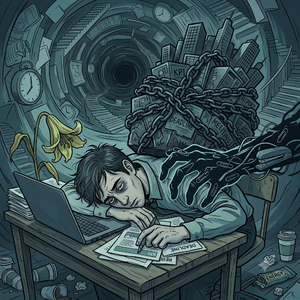
你是不是也经常被人说“一眼看上去班味很重”?每天早起打卡、疯狂通勤、外卖对付,洗把脸镜子里只有一张写满憔悴和黑眼圈的“垮脸”。这期节目,我们从让皮肤又干又粗糙的压力激素皮质醇,再到久坐引发的“死屁股综合征”;从外卖超加工食品对肠道微生物的降维打击,到熬夜如何悄悄修改你的表观遗传年龄……更好玩的是,班味居然不是人类的专利!职场高压、疯狂接客的清洁鱼也会靠机会主义“摸鱼宰客”;而大自然甚至用“懒蚂蚁”的生存智慧告诉我们:为了不集体燃尽,社会必须养闲人!
既然最完美的解药“辞职”难以实现,那就跟我们一起深呼吸,从细胞和微观能量学的角度,找回那个不被磨损的自己吧!
加听友群请加小导游:bio_kiwi
本期提到的节目:https://www.xiaoyuzhoufm.com/episode/677c138ecda04ef4c1d842b0
时间点:
01:41 节目开场:从生命科学角度聊聊何为“班味”
03:39 语言学视角:班味进化的三个阶段
05:32 科学定义“累”:从轻度疲劳到全面燃尽
10:06 职业倦怠(Burnout):它其实是一种职业疾病
13:05 视觉上的班味:为什么熬夜后脸会垮掉?
17:57 压力与长痘:皮肤其实是内分泌免疫器官
21:23 炎症衰老:面相看起来更老的人死得更早?
25:53 如何消除班味?多去公园做做“人类丰容”
28:28 被工作反复拨动的“压力激素”皮质醇
35:04 闻得到的班味:汗液如何传递焦虑情绪?
38:11 办公室里的“人味”:脑雾背后的空气双盲实验
44:12 久坐的代价:你听说过“死屁股综合征”吗?
49:00 爱运动的沙发土豆:健身房救不了久坐危害
52:46 窒息的通勤:距离越远,越肥越抑郁?
57:28 外卖的暴击:超加工食品如何破坏肠道?
01:02:49 熬夜的遗传代价:夜班正加速你的表观年龄
01:06:59 终极科学概念:用“稳态负荷”完美定义班味
01:13:29 跨物种班味:居家摸鱼和自发转岗的工蜂
01:19:09 懒蚂蚁与弹性池:企业为什么必须养闲人?
01:23:37 裂唇鱼的职场:疯狂接客的服务业与机会主义欺骗
01:28:00 能量学模型:别随遇而安,尽力摆脱班味
节目提及的图片:
每天身体的皮质醇浓度曲线:
裂唇鱼:
片尾曲:感觉身体被掏空 - 上海彩虹合唱团
部分提及参考资料:
Mauss, D., Li, J., Schmidt, B., Angerer, P., & Jarczok, M. N. (2015). Measuring allostatic load in the workforce: a systematic review. Industrial Health, 53(1), 5–20. https://pmc.ncbi.nlm.nih.gov/articles/PMC4331190/
World Health Organization. (2019-05-28). Burn-out an "occupational phenomenon": International Classification of Diseases. WHO News. https://www.who.int/news/item/28-05-2019-burn-out-an-occupational-phenomenon-international-classification-of-diseases
Edú-Valsania, S., Laguía, A., & Moriano, J. A. (2022). Burnout: A review of theory and measurement. International Journal of Environmental Research and Public Health, 19(3), 1780. https://doi.org/10.3390/ijerph19031780
Porr, C., Olson, K., & Hegadoren, K. (2010). Tiredness, fatigue, and exhaustion in the context of a major depressive disorder. Qualitative Health Research, 20(10), 1315–1326. https://doi.org/10.1177/1049732310370841
Bower, J. E. (2014). Cancer-related fatigue — mechanisms, risk factors, and treatments. Nature Reviews Clinical Oncology, 11(10), 597–609. https://doi.org/10.1038/nrclinonc.2014.127
Sundelin, T., Lekander, M., Sorjonen, K., & Axelsson, J. (2017). Negative effects of restricted sleep on facial appearance and social appeal. Royal Society Open Science, 4(5), 160918. https://doi.org/10.1098/rsos.160918
Lin, T.-K., Zhong, L., & Santiago, J. L. (2018). Psychological stress deteriorates skin barrier function by activating 11β-hydroxysteroid dehydrogenase 1 and the HPA axis. Scientific Reports, 8, 6760. https://doi.org/10.1038/s41598-018-24653-z
Walter, A., Stoll, V., Mahmut, M. K., Croy, I., Mutic, S., & Mujica-Parodi, L. R. (2025). Enhanced sensitivity to odors due to chemosignals associated with anxiety. Communications Chemistry, 8, 88. https://doi.org/10.1038/s42004-025-01512-3
Wang, N., Ernle, L., Bekö, G., Wargocki, P., & Williams, J. (2024). Volatile organic compounds emitted by humans indoors — A review on the measurement, test conditions, and analysis techniques. Building and Environment, 258, 111503. https://doi.org/10.1016/j.buildenv.2024.111503
Tang, X., Misztal, P. K., Nazaroff, W. W., & Goldstein, A. H. (2022). Emission rates of volatile organic compounds from humans. Environmental Science & Technology, 56(8), 4838–4848. https://doi.org/10.1021/acs.est.1c08764
Gilbert, J. A., & Hartmann, E. M. (2024). The indoors microbiome and human health. Nature Reviews Microbiology, 22(11), 742–755. https://doi.org/10.1038/s41579-024-01077-3
Allen, J. G., MacNaughton, P., Satish, U., Santanam, S., Vallarino, J., & Spengler, J. D. (2016). Associations of cognitive function scores with carbon dioxide, ventilation, and volatile organic compound exposures in office workers: A controlled exposure study of green and conventional office environments. Environmental Health Perspectives, 124(6), 805–812. https://doi.org/10.1289/ehp.1510037
Gao, W., Sanna, M., Chen, Y.-H., Tsai, M.-K., & Wen, C. P. (2024). Occupational sitting time, leisure physical activity, and all-cause and cardiovascular disease mortality. JAMA Network Open, 7(1), e2350680. https://doi.org/10.1001/jamanetworkopen.2023.50680
Loh, R., Stamatakis, E., Folkerts, D., Allgrove, J. E., & Moir, H. J. (2020). Effects of interrupting prolonged sitting on postprandial glycemia and insulin responses: A network meta-analysis. Journal of Sport and Health Science, 9(6), 553–563. https://doi.org/10.1016/j.jshs.2020.12.006
Dunstan, D. W., Kingwell, B. A., Larsen, R., Healy, G. N., Cerin, E., Hamilton, M. T., … Owen, N. (2012). Breaking up prolonged sitting reduces postprandial glucose and insulin responses. Diabetes Care, 35(5), 976–983. https://doi.org/10.2337/dc11-1931
Eddy, P., Heckenberg, R., Wertheim, E. H., Kent, S., & Wright, B. J. (2023). Work-related psychosocial factors and inflammatory markers: A systematic review and meta-analysis. Journal of Psychosomatic Research, 173, 111470. https://doi.org/10.1016/j.jpsychores.2023.111470
Järvelin-Pasanen, S., Sinikallio, S., & Tarvainen, M. P. (2022). Objective assessment of mental stress in individuals with different levels of effort reward imbalance or overcommitment using heart rate variability: A systematic review. Systematic Reviews, 11(1), 48. https://doi.org/10.1186/s13643-022-01925-4
Janssens, H., Clays, E., Fiers, T., Verstraete, A. G., De Bacquer, D., & Braeckman, L. (2021). The potential of using hair cortisol to measure chronic stress in occupational healthcare; a scoping review. Journal of Occupational Health, 63(1), e12189. https://doi.org/10.1002/1348-9585.12189
White, A. J., Kresovich, J. K., Xu, Z., Sandler, D. P., & Taylor, J. A. (2019). Shift work, DNA methylation and epigenetic age. International Journal of Epidemiology, 48(5), 1536–1544. https://doi.org/10.1093/ije/dyz027
Bobba-Alves, N., Sturm, G., Lin, J., Ware, S. A., Karan, K. R., Monzel, A. S., … Picard, M. (2023). Cellular allostatic load is linked to increased energy expenditure and accelerated biological aging. Psychoneuroendocrinology, 155, 106322. https://doi.org/10.1016/j.psyneuen.2023.106322
Fields, C. J., Mallott, E. K., Pearson, J., Burnham, E. L., & Amato, K. R. (2024). Biological, environmental, and psychological stress and the human gut microbiome in healthy adults. Scientific Reports, 14, 27735. https://doi.org/10.1038/s41598-024-77473-9
Foster, J. A., Rinaman, L., & Cryan, J. F. (2017). Stress & the gut-brain axis: Regulation by the microbiome. Neurobiology of Stress, 7, 124–136. https://doi.org/10.1016/j.ynstr.2017.03.001
Pega, F., Náfrádi, B., Momen, N. C., Ujita, Y., Streicher, K. N., Prüss-Üstün, A. M., … Woodruff, T. J. (2021). Global, regional, and national burdens of ischemic heart disease and stroke attributable to exposure to long working hours for 194 countries, 2000–2016: A systematic analysis from the WHO/ILO Joint Estimates of the Work-related Burden of Disease and Injury. Environment International, 154, 106595. https://doi.org/10.1016/j.envint.2021.106595
WHO. (2021-05-17). Long working hours increasing deaths from heart disease and stroke: WHO, ILO. WHO News. https://www.who.int/news/item/17-05-2021-long-working-hours-increasing-deaths-from-heart-disease-and-stroke-who-ilo
Klimas, N. G., Broderick, G., & Fletcher, M. A. (2012). Biomarkers for chronic fatigue. Brain, Behavior, and Immunity, 26(8), 1202–1210.
Adamowicz, J. L., Vélez-Bermúdez, M., & Thomas, E. B. K. (2022). Fatigue severity and avoidance among individuals with chronic disease: A meta-analysis. Journal of Psychosomatic Research, 159, 110951.
Thong, M. S. Y., van Noorden, C. J. F., Steindorf, K., & Arndt, V. (2020). Cancer-related fatigue: Causes and current treatment options. Current Treatment Options in Oncology, 21, 17.
既然最完美的解药“辞职”难以实现,那就跟我们一起深呼吸,从细胞和微观能量学的角度,找回那个不被磨损的自己吧!
加听友群请加小导游:bio_kiwi
本期提到的节目:https://www.xiaoyuzhoufm.com/episode/677c138ecda04ef4c1d842b0
时间点:
01:41 节目开场:从生命科学角度聊聊何为“班味”
03:39 语言学视角:班味进化的三个阶段
05:32 科学定义“累”:从轻度疲劳到全面燃尽
10:06 职业倦怠(Burnout):它其实是一种职业疾病
13:05 视觉上的班味:为什么熬夜后脸会垮掉?
17:57 压力与长痘:皮肤其实是内分泌免疫器官
21:23 炎症衰老:面相看起来更老的人死得更早?
25:53 如何消除班味?多去公园做做“人类丰容”
28:28 被工作反复拨动的“压力激素”皮质醇
35:04 闻得到的班味:汗液如何传递焦虑情绪?
38:11 办公室里的“人味”:脑雾背后的空气双盲实验
44:12 久坐的代价:你听说过“死屁股综合征”吗?
49:00 爱运动的沙发土豆:健身房救不了久坐危害
52:46 窒息的通勤:距离越远,越肥越抑郁?
57:28 外卖的暴击:超加工食品如何破坏肠道?
01:02:49 熬夜的遗传代价:夜班正加速你的表观年龄
01:06:59 终极科学概念:用“稳态负荷”完美定义班味
01:13:29 跨物种班味:居家摸鱼和自发转岗的工蜂
01:19:09 懒蚂蚁与弹性池:企业为什么必须养闲人?
01:23:37 裂唇鱼的职场:疯狂接客的服务业与机会主义欺骗
01:28:00 能量学模型:别随遇而安,尽力摆脱班味
节目提及的图片:
每天身体的皮质醇浓度曲线:
裂唇鱼:
片尾曲:感觉身体被掏空 - 上海彩虹合唱团
部分提及参考资料:
Mauss, D., Li, J., Schmidt, B., Angerer, P., & Jarczok, M. N. (2015). Measuring allostatic load in the workforce: a systematic review. Industrial Health, 53(1), 5–20. https://pmc.ncbi.nlm.nih.gov/articles/PMC4331190/
World Health Organization. (2019-05-28). Burn-out an "occupational phenomenon": International Classification of Diseases. WHO News. https://www.who.int/news/item/28-05-2019-burn-out-an-occupational-phenomenon-international-classification-of-diseases
Edú-Valsania, S., Laguía, A., & Moriano, J. A. (2022). Burnout: A review of theory and measurement. International Journal of Environmental Research and Public Health, 19(3), 1780. https://doi.org/10.3390/ijerph19031780
Porr, C., Olson, K., & Hegadoren, K. (2010). Tiredness, fatigue, and exhaustion in the context of a major depressive disorder. Qualitative Health Research, 20(10), 1315–1326. https://doi.org/10.1177/1049732310370841
Bower, J. E. (2014). Cancer-related fatigue — mechanisms, risk factors, and treatments. Nature Reviews Clinical Oncology, 11(10), 597–609. https://doi.org/10.1038/nrclinonc.2014.127
Sundelin, T., Lekander, M., Sorjonen, K., & Axelsson, J. (2017). Negative effects of restricted sleep on facial appearance and social appeal. Royal Society Open Science, 4(5), 160918. https://doi.org/10.1098/rsos.160918
Lin, T.-K., Zhong, L., & Santiago, J. L. (2018). Psychological stress deteriorates skin barrier function by activating 11β-hydroxysteroid dehydrogenase 1 and the HPA axis. Scientific Reports, 8, 6760. https://doi.org/10.1038/s41598-018-24653-z
Walter, A., Stoll, V., Mahmut, M. K., Croy, I., Mutic, S., & Mujica-Parodi, L. R. (2025). Enhanced sensitivity to odors due to chemosignals associated with anxiety. Communications Chemistry, 8, 88. https://doi.org/10.1038/s42004-025-01512-3
Wang, N., Ernle, L., Bekö, G., Wargocki, P., & Williams, J. (2024). Volatile organic compounds emitted by humans indoors — A review on the measurement, test conditions, and analysis techniques. Building and Environment, 258, 111503. https://doi.org/10.1016/j.buildenv.2024.111503
Tang, X., Misztal, P. K., Nazaroff, W. W., & Goldstein, A. H. (2022). Emission rates of volatile organic compounds from humans. Environmental Science & Technology, 56(8), 4838–4848. https://doi.org/10.1021/acs.est.1c08764
Gilbert, J. A., & Hartmann, E. M. (2024). The indoors microbiome and human health. Nature Reviews Microbiology, 22(11), 742–755. https://doi.org/10.1038/s41579-024-01077-3
Allen, J. G., MacNaughton, P., Satish, U., Santanam, S., Vallarino, J., & Spengler, J. D. (2016). Associations of cognitive function scores with carbon dioxide, ventilation, and volatile organic compound exposures in office workers: A controlled exposure study of green and conventional office environments. Environmental Health Perspectives, 124(6), 805–812. https://doi.org/10.1289/ehp.1510037
Gao, W., Sanna, M., Chen, Y.-H., Tsai, M.-K., & Wen, C. P. (2024). Occupational sitting time, leisure physical activity, and all-cause and cardiovascular disease mortality. JAMA Network Open, 7(1), e2350680. https://doi.org/10.1001/jamanetworkopen.2023.50680
Loh, R., Stamatakis, E., Folkerts, D., Allgrove, J. E., & Moir, H. J. (2020). Effects of interrupting prolonged sitting on postprandial glycemia and insulin responses: A network meta-analysis. Journal of Sport and Health Science, 9(6), 553–563. https://doi.org/10.1016/j.jshs.2020.12.006
Dunstan, D. W., Kingwell, B. A., Larsen, R., Healy, G. N., Cerin, E., Hamilton, M. T., … Owen, N. (2012). Breaking up prolonged sitting reduces postprandial glucose and insulin responses. Diabetes Care, 35(5), 976–983. https://doi.org/10.2337/dc11-1931
Eddy, P., Heckenberg, R., Wertheim, E. H., Kent, S., & Wright, B. J. (2023). Work-related psychosocial factors and inflammatory markers: A systematic review and meta-analysis. Journal of Psychosomatic Research, 173, 111470. https://doi.org/10.1016/j.jpsychores.2023.111470
Järvelin-Pasanen, S., Sinikallio, S., & Tarvainen, M. P. (2022). Objective assessment of mental stress in individuals with different levels of effort reward imbalance or overcommitment using heart rate variability: A systematic review. Systematic Reviews, 11(1), 48. https://doi.org/10.1186/s13643-022-01925-4
Janssens, H., Clays, E., Fiers, T., Verstraete, A. G., De Bacquer, D., & Braeckman, L. (2021). The potential of using hair cortisol to measure chronic stress in occupational healthcare; a scoping review. Journal of Occupational Health, 63(1), e12189. https://doi.org/10.1002/1348-9585.12189
White, A. J., Kresovich, J. K., Xu, Z., Sandler, D. P., & Taylor, J. A. (2019). Shift work, DNA methylation and epigenetic age. International Journal of Epidemiology, 48(5), 1536–1544. https://doi.org/10.1093/ije/dyz027
Bobba-Alves, N., Sturm, G., Lin, J., Ware, S. A., Karan, K. R., Monzel, A. S., … Picard, M. (2023). Cellular allostatic load is linked to increased energy expenditure and accelerated biological aging. Psychoneuroendocrinology, 155, 106322. https://doi.org/10.1016/j.psyneuen.2023.106322
Fields, C. J., Mallott, E. K., Pearson, J., Burnham, E. L., & Amato, K. R. (2024). Biological, environmental, and psychological stress and the human gut microbiome in healthy adults. Scientific Reports, 14, 27735. https://doi.org/10.1038/s41598-024-77473-9
Foster, J. A., Rinaman, L., & Cryan, J. F. (2017). Stress & the gut-brain axis: Regulation by the microbiome. Neurobiology of Stress, 7, 124–136. https://doi.org/10.1016/j.ynstr.2017.03.001
Pega, F., Náfrádi, B., Momen, N. C., Ujita, Y., Streicher, K. N., Prüss-Üstün, A. M., … Woodruff, T. J. (2021). Global, regional, and national burdens of ischemic heart disease and stroke attributable to exposure to long working hours for 194 countries, 2000–2016: A systematic analysis from the WHO/ILO Joint Estimates of the Work-related Burden of Disease and Injury. Environment International, 154, 106595. https://doi.org/10.1016/j.envint.2021.106595
WHO. (2021-05-17). Long working hours increasing deaths from heart disease and stroke: WHO, ILO. WHO News. https://www.who.int/news/item/17-05-2021-long-working-hours-increasing-deaths-from-heart-disease-and-stroke-who-ilo
Klimas, N. G., Broderick, G., & Fletcher, M. A. (2012). Biomarkers for chronic fatigue. Brain, Behavior, and Immunity, 26(8), 1202–1210.
Adamowicz, J. L., Vélez-Bermúdez, M., & Thomas, E. B. K. (2022). Fatigue severity and avoidance among individuals with chronic disease: A meta-analysis. Journal of Psychosomatic Research, 159, 110951.
Thong, M. S. Y., van Noorden, C. J. F., Steindorf, K., & Arndt, V. (2020). Cancer-related fatigue: Causes and current treatment options. Current Treatment Options in Oncology, 21, 17.

外观