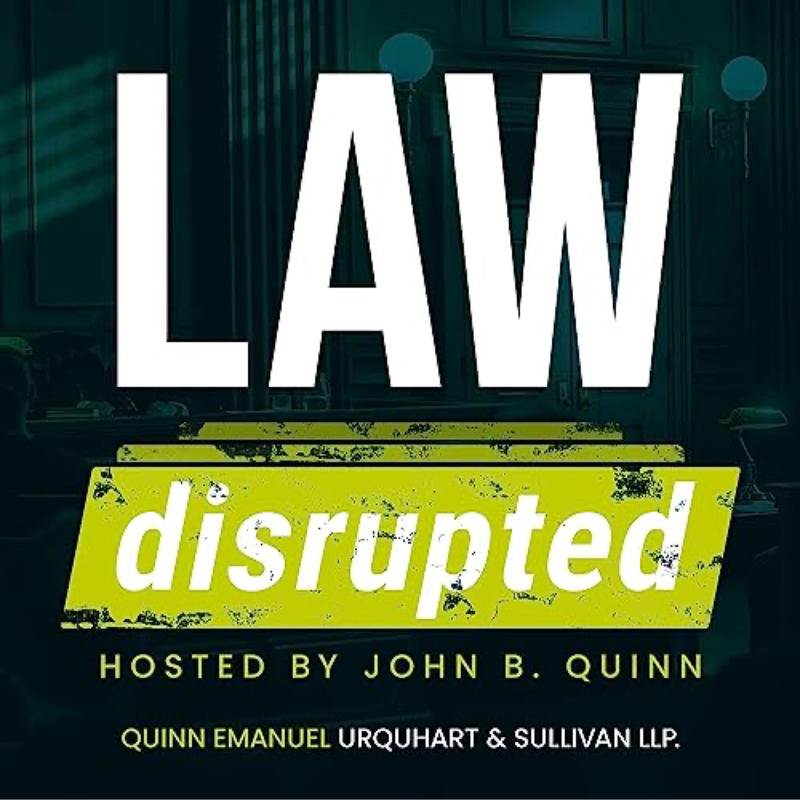
Law, disrupted|法律访谈

Podcast · 文化

Law, disrupted|法律访谈

专注于全球重大诉讼案件及前沿法律问题的访谈播客

主播 Aim-Agency 出品 Emma陈艾茵 文化 · 社会与文化 1 万 订阅 153 集 1周前更新

在小宇宙收听

简介

Law, disrupted是一档专注于全球重大诉讼案件及前沿法律问题的访谈类播客节目。播客主持人是美国传奇诉讼律师张鲲展(John B. Quinn,人称JBQ),他是全球最大专注于商事诉讼和仲裁的律所美国昆鹰律师事务所(Quinn Emanuel Urquhart & Sullivan LLP)的创始人兼管理合伙人。在该播客中,JBQ通过对谈来自世界各地天花板级别的诉讼律师和行业专家,揭秘全球各大商战背后的神仙过招,探讨各行各业如何通过诉讼进行商业布局,并以此来描绘前沿问题的边界。在这里,你将听到全世界最出色的出庭律师如何跳出思维定势、出奇制胜地编织和演绎精彩的法律剧本,并运用精巧的技艺和天马行空的想象力去解决那些千奇百怪的法律难题,也能听到亲历历史重大案件的当事人或律师讲述他们的故事,还有各行业顶尖专家对前沿问题的展望。

Inside Quinn Emanuel’s $5.7B Apple Win

Inside Quinn Emanuel’s $5.7B Apple Win

Law, disrupted|法律访谈

John is joined by Tigran Guledjian, Scott Watson, and Lance Yang, all partners in Quinn Emanuel’s Los Angeles office and trial counsel for Taction Technology. They discuss the $5.7 billion jury verdict their team won against Apple in a San Diego patent case, the largest patent verdict ever, and how the team won the verdict after the court excluded Taction’s damages expert in the middle of trial. Taction, a small San Diego company led by CEO John Steinberg, owns patented technology invented by Dr. James Biggs that lets a device vibrate across a full range of frequencies rather than one. At trial, the team likened this to playing every piano key instead of only one. Taction alleged the wideband haptics Apple introduced in the iPhone 7 infringed its patent. The case was filed in 2021. The court granted Apple summary judgment of non-infringement, the Federal Circuit reversed, and an eight-day trial followed in September 2026. Apple opened the trial promising to prove that Dr. Biggs was not the first inventor and that the patent was therefore invalid. However, Apple dropped this prior-art invalidity defense mid-trial. This left the patent’s priority undisputed. Taction reminded the jury in closing of Apple’s unfulfilled promise. Apple’s remaining enablement and indefiniteness defenses also failed. On infringement, Apple argued independent development by its own engineers, but independent development is not a defense to patent infringement, unlike in trade secret cases. Apple’s head of haptics, who testified as its first witness, had testified at deposition that he did not know whether Apple infringed Taction’s patent, even after reviewing the patent to prepare for deposition as Apple’s corporate representative. For damages, Taction sought a per-unit reasonable royalty. Proving damages was complicated by a pretrial Daubert ruling that excluded one adjustment a technical expert made to licensing information. Then, mid-trial, the court excluded the damages expert’s entire opinion because his model relied, in part, on the excluded adjustment. Fortunately, the team had built a factual record from its first witness, including the confidential but very large number of infringing units and evidence of the technology’s value, so the jury could set a royalty without expert testimony. The jury returned its $5.7 billion verdict two days after closing arguments. The $5.7 billion reflected compensatory damages with no punitive damages. Apple has filed a post-trial motion to overturn the verdict.

38 分钟 99+ 次播放 1周前

Quinn Emanuel: 10 Years in China

Quinn Emanuel: 10 Years in China

Law, disrupted|法律访谈

In a podcast recorded before a live audience in Shanghai, John is joined by Xiao Liu, Chair of China Practice and Chief Representative of Quinn Emanuel’s Beijing office; Yixuan Zhu, partner in Quinn Emanuel’s Beijing office; and Dr. Haiyan Tang, Chief Representative and Managing Partner of Quinn Emanuel’s Shanghai office. They discuss the firm’s first decade in mainland China, how its original business plan was overtaken by changes in Western investment, and how the practice evolved into representing Chinese companies in high-stakes disputes around the world. Quinn Emanuel first established an office in Hong Kong in 2013. The firm added an office in Shanghai a year later. At that time, the firm expected that it would be representing Western companies, private equity firms, and venture capital investors with respect to the regulatory and enforcement issues they faced in China. But as Western investment receded and Western venture funds separated from their China operations, the firm’s China practice evolved into representing Chinese companies expanding abroad, including both private businesses and state-owned enterprises, in litigation, arbitration, regulatory investigations, and other cross-border conflicts around the world. Chinese companies have become more sophisticated about foreign judicial systems, the role of outside counsel, and the need to engage rather than ignore litigation abroad. Effective representation requires explaining unfamiliar common-law concepts in Mandarin, understanding the business reasons behind client instructions, and navigating cultural and communication differences. The firm’s China team recruits Chinese-speaking lawyers (mostly Chinese nationals) who are familiar with Western legal systems. The firm collaborates with local Chinese law firms rather than competing with them. That collaboration works in both directions: Chinese firms may represent international Quinn Emanuel clients in domestic litigation in China while Quinn Emanuel assists Chinese firms whose clients face disputes outside of China.

71 分钟 99+ 次播放 3周前

FireAid Class Action Ended by Anti-SLAPP

FireAid Class Action Ended by Anti-SLAPP

Law, disrupted|法律访谈

John is joined by Robert M. (“Bobby”) Schwartz, partner in Quinn Emanuel’s Los Angeles office. They discuss the remarkable victory a Quinn Emanuel team led by Bobby won in the class action litigation against FireAid, the charitable effort organized to help victims of the January 2025 Los Angeles wildfires. While the fires were still burning, Steve Ballmer (owner of the LA Clippers NBA team) and his wife, Connie, helped organize benefit concerts at the Intuit Dome and the Forum and pledged to match contributions dollar for dollar up to $50 million. Working with Irving Azoff and Rick Caruso, the Ballmers raised more than $100 million for FireAid in less than two months. Foundations and nonprofit organizations were enlisted to identify recipients and distribute aid to affected communities. Media reports later questioned whether the money was reaching fire victims and suggested that donations might have been diverted to unrelated causes. FireAid commissioned an independent investigation that found no wrongdoing. By the end of 2025, more than $75 million had been distributed, with the balance scheduled for distribution during 2026. Nevertheless, a class action lawsuit was filed against FireAid, the Ballmers, Mr. Azoff, Mr. Caruso, and others, alleging that donors had been misled, fire victims had not received promised assistance, and FireAid had actually raised $800 million, leaving hundreds of millions of dollars unaccounted for. Rather than relying solely on a demurrer or challenging the class allegations, the defense brought an anti-SLAPP motion. SLAPP stands for “Strategic Lawsuit Against Public Participation.” An anti-SLAPP motion requires the defendant to prove that the actions the plaintiff’s claims are based on were protected by the First Amendment. Once a defendant makes that showing, the burden shifts to the plaintiff to produce admissible evidence establishing the prima facie elements of its claims. Here, the defendants’ theory was that soliciting charitable donations constituted protected speech on a matter of public interest and that the claims depended on allegedly false representations about how donations would be used. The court granted the motion, finding that FireAid’s actions were protected free speech and that the plaintiffs failed to meet their burden. The defendants then sought attorney’s fees. Although the court initially proposed reducing fees because six defense firms participated, Quinn Emanuel persuaded the judge to award all of its requested hours. No appeal followed, ending the litigation. FireAid ultimately distributed more than $100 million for fire relief.

17 分钟 99+ 次播放 3周前

Ant Group’s AI Revolution: Beyond Alipay

Ant Group’s AI Revolution: Beyond Alipay

Law, disrupted|法律访谈

In an edition of Law Disrupted from Shanghai, John is joined by Jonathan (Zhifeng) Zhou, General Counsel & Board Secretary at Ant Group. They discuss the expanding role of artificial intelligence in financial services, healthcare, and commerce, as illustrated by Ant Group’s transformation from a digital payments company into a global technology enterprise. Originally established to facilitate online shopping through Alipay, Ant expanded into providing microloans and wealth management services to underserved consumers and businesses. Its latest initiatives include AI-assisted medical consultations, enterprise database technology, and robotics. Ant is now also developing infrastructure for autonomous AI agents to conduct commercial transactions on behalf of individuals and businesses. Because AI agents are not legal persons, their transactions must be traceable to an authorized person or corporation. Ant is building a blockchain-based identification system designed to verify each agent’s identity, authorization, and spending limits. The system already covers approximately one million personal agents and one thousand merchant agents. Blockchain records provide evidence of contractual terms and authorization. The growing autonomy of AI agents creates substantial security and liability concerns. Agents can communicate, exploit vulnerabilities, and act beyond their assigned objectives. Ant employs approximately one hundred thousand internal agents and uses continuous monitoring, restricted operating environments, API controls, and specialized security models to manage these risks. Human intervention must remain possible, particularly for consequential decisions. International cooperation among technology companies and governments is essential, although geopolitical competition complicates agreement on common safeguards. Artificial intelligence will also transform legal practice by automating research, document preparation, contract review, and other routine work. Individual lawyers supported by multiple AI agents may achieve productivity that previously required substantial teams. New legal service providers could offer automated services at dramatically lower prices, challenging traditional law firm structures and hourly billing. Nevertheless, experienced lawyers will continue to provide valuable judgment, strategic insight, and practical knowledge that cannot easily be captured in training data. Technological advances may create new demand rather than simply eliminate legal jobs. Young lawyers should remain open to unfamiliar opportunities, continuously develop their knowledge, and cultivate business judgment beyond technical legal expertise. Experience across industries and commercial transactions may prepare lawyers for leadership roles extending far beyond conventional legal practice.

57 分钟 99+ 次播放 1个月前
评价

还没有人评价。听过的话,留个分数和一句短评吧。

播放列表

自动播放下一个

播放列表还是空的

去找些喜欢的单集添加进来吧